Last updated July 2026 · Stay Off The Roof — Outdoor Lighting Experts · ROC #344820 · Serving Paradise Valley
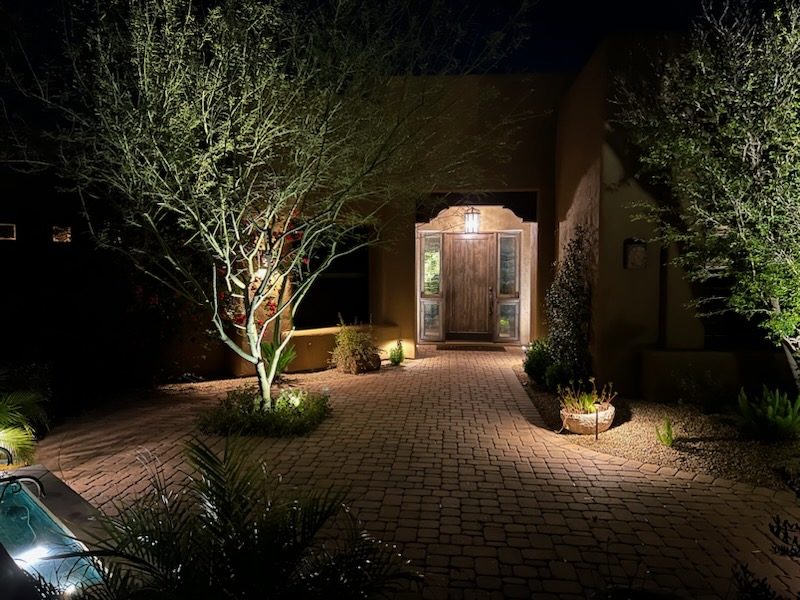
Paradise Valley regulates outdoor lighting at the town level rather than leaving it to HOAs, which makes it stricter than almost anywhere else in the Valley. The town’s low-density, dark-sky character was deliberately protected through ordinances limiting outdoor lighting, and the zoning ordinance carries a dedicated section governing the brightness of outdoor lights. If you’re designing landscape lighting for a Paradise Valley property, the town is the authority you’re designing around — not a homeowners association.
Why Paradise Valley is different
Most Valley cities leave residential lighting largely to HOA design guidelines. Paradise Valley doesn’t have that structure across most of the town — the municipality itself sets the standard, and it was built specifically to preserve the dark, low-density feel that residents incorporated the town to protect in the first place.
Practically, that means a design that would sail through review in Scottsdale or Chandler can run into trouble here. It also means the town’s rules apply consistently across the property rather than varying by subdivision — which, once you know them, is easier to design to.
Driveway entry markers have a specific limit
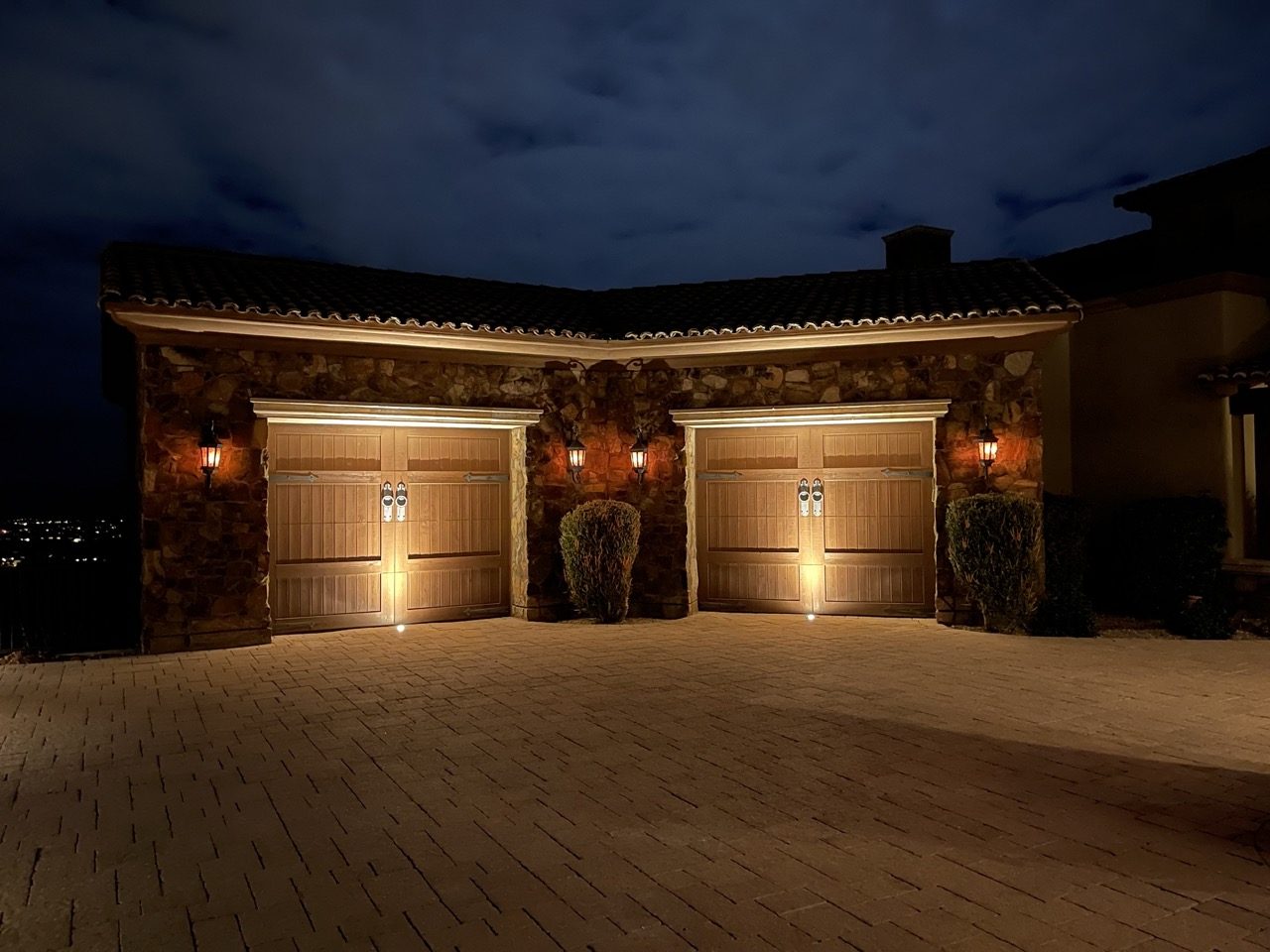
This is the rule that catches people most often, because entry markers are exactly what estate owners want lit. Under the town’s zoning ordinance, an illuminated driveway entry marker is limited in both height and output — the total height of the marker together with its light is capped, and the light source itself is limited to a low lumen output. Markers also can’t be placed within the town right-of-way or private road areas.
The practical consequence: a bright fixture on top of a tall stone entry pier is not a design you can execute here. What works instead is lighting the pier itself from below or from a shielded source, keeping the visible light source modest, and letting the material do the work rather than the wattage.
Verify current figures with the Town before designing — lighting code gets amended periodically, and the numbers in force when you build are the ones that matter.
Hillside lots carry additional rules
Properties on Camelback, Mummy Mountain, and the other hillside areas fall under the town’s Hillside Building Regulations, which exist precisely because lighting on elevated terrain is visible from far more of the town than lighting on a flat lot. A fixture that’s unremarkable at street level reads as a beacon when it’s two hundred feet up a slope.
Design-wise this pushes hard toward shielded, downward-directed, low-output fixtures and away from anything that throws light outward or upward past its target. Which is generally better lighting anyway — the restraint that hillside rules force tends to produce a more sophisticated result than an unrestricted design would.
Designing well inside the constraints
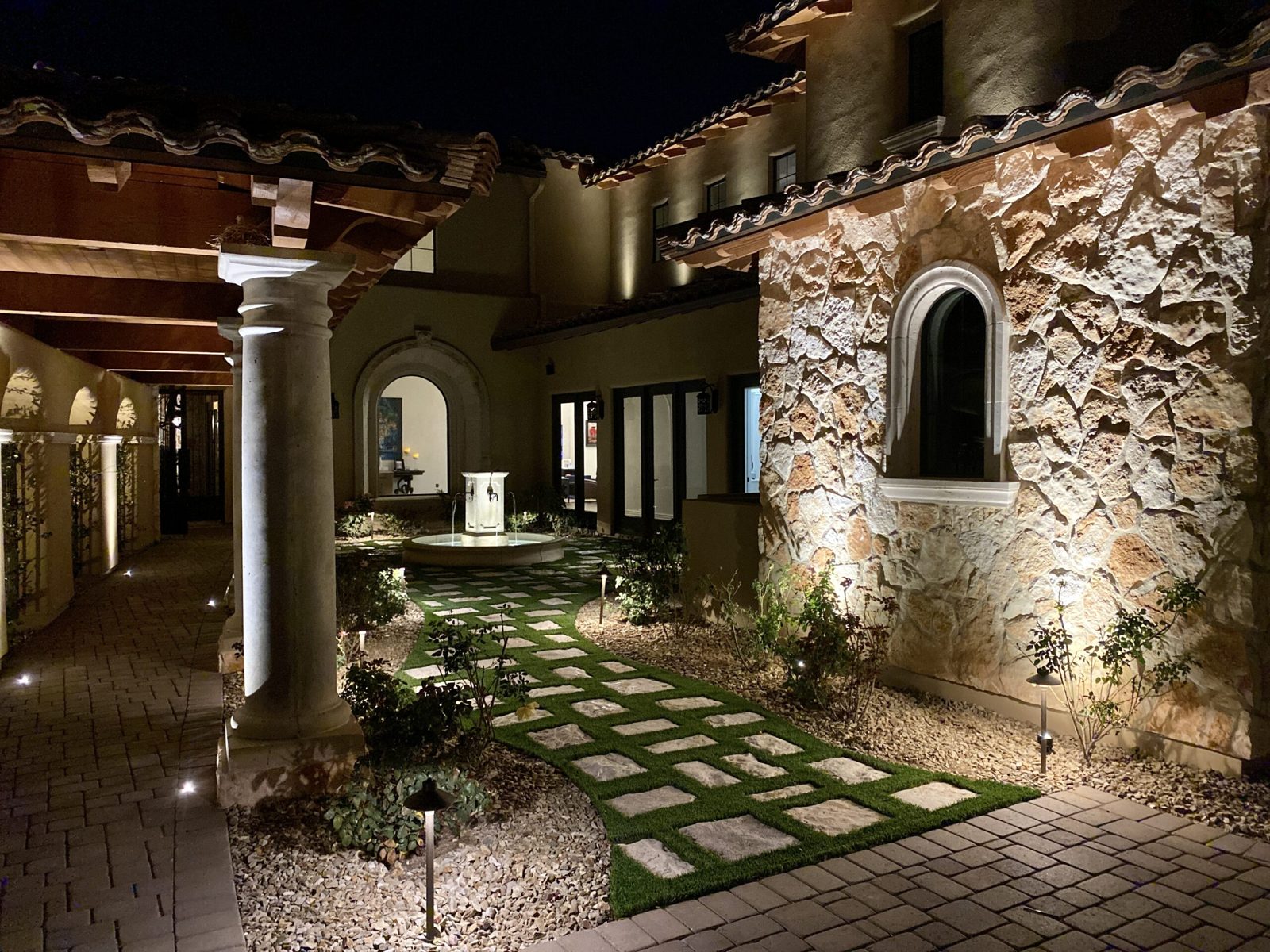
The temptation on a large estate property is to light everything. In Paradise Valley that’s neither permitted nor attractive. Most of the usual landscape lighting ideas for a home still work here; they just get executed at lower output with every source shielded. What works:
- Shield every source. The fixture should be invisible; only its effect should be apparent. This is the single principle that keeps a design compliant and elegant simultaneously.
- Light fewer things, deliberately. Three specimen saguaros and a wall are more striking than twenty fixtures at low output scattered across an acre — see uplighting a mature saguaro for the specimen technique.
- Keep light on your property. Light trespass across a boundary is the fastest route to a neighbour complaint, and on one-acre-plus lots with long sightlines it’s easier to cause than you’d think.
- Wash walls rather than spotlighting features. Estate properties here are typically walled, and a softly washed wall reads beautifully at low output while a spotlight on a feature needs far more.
- Zone and schedule. Entry and drive can run later; the rear garden can shut down earlier. Less total light, running less of the night.
The electrical still matters more here
Paradise Valley lots are large, which means long wire runs and the voltage-drop problems that come with them. A low-output design is more sensitive to voltage drop, not less — when a fixture is already running modestly by design, losing voltage on a long run pushes it into visibly dim and colour-shifted territory faster.
Multiple transformers placed near their loads, heavier wire on distant runs, and runs calculated individually all matter more on an estate property with a restrained lighting scheme than they would on a small lot running bright. More on that in landscape lighting for large properties.
What it costs
Our packages start at $2,500, and a typical Phoenix front-yard design runs $3,000 to $7,000 installed. Paradise Valley properties generally sit above that range — acre-plus lots, longer runs, multiple transformers, and specimen-heavy landscapes all push the number up. What drives it is covered in what separates a $4,000 job from a $15,000 one.
See landscape lighting for how a full design comes together, architectural lighting for the house itself, or Paradise Valley outdoor lighting for everything we do in town.
Frequently Asked Questions
Does Paradise Valley restrict residential outdoor lighting?
Yes. The town regulates outdoor lighting through its zoning ordinance, which includes a dedicated section on the brightness of outdoor lights. Limiting outdoor lighting was one of the mechanisms used to preserve the town’s low-density character, and the rules are generally stricter than surrounding municipalities.
Are there special rules for hillside properties?
Yes. Hillside areas fall under the town’s Hillside Building Regulations, which apply additional guidance to development on elevated terrain. Lighting on a slope is visible across much more of the town than lighting on a flat lot, so shielded and downward-directed fixtures matter considerably more.
Can I light my driveway entry marker?
Yes, within limits. The zoning ordinance caps the combined height of the marker and its light, restricts the lumen output of the light source, and prohibits placement within the town right-of-way or private road areas. Confirm current figures with the Town before designing, since the lighting code is amended periodically.
Do I need approval before installing landscape lighting?
Requirements depend on the scope of work and whether the property is in a hillside area. The Town is the authority to ask, and it’s worth asking before design rather than after installation. We handle that conversation as part of the design process.
Estate lighting, designed to the town’s rules.
Free after-dark design walk in Paradise Valley. We design. You shine.

