
Last updated July 2026 · Stay Off The Roof — Outdoor Lighting Experts · ROC #344820 · Phoenix metro
Above roughly a half acre, landscape lighting stops being a fixture problem and becomes an electrical one. On a standard 7,000 square foot lot, almost any competent installer can put a transformer on the wall and run wire to twenty fixtures without thinking hard. Stretch that same approach across 20,000 square feet and the far fixtures come on visibly dimmer, colour shifts warm and muddy at the end of the run, and lamps start failing early. Nothing looks obviously broken — it just never looks right, and nobody can tell you why.
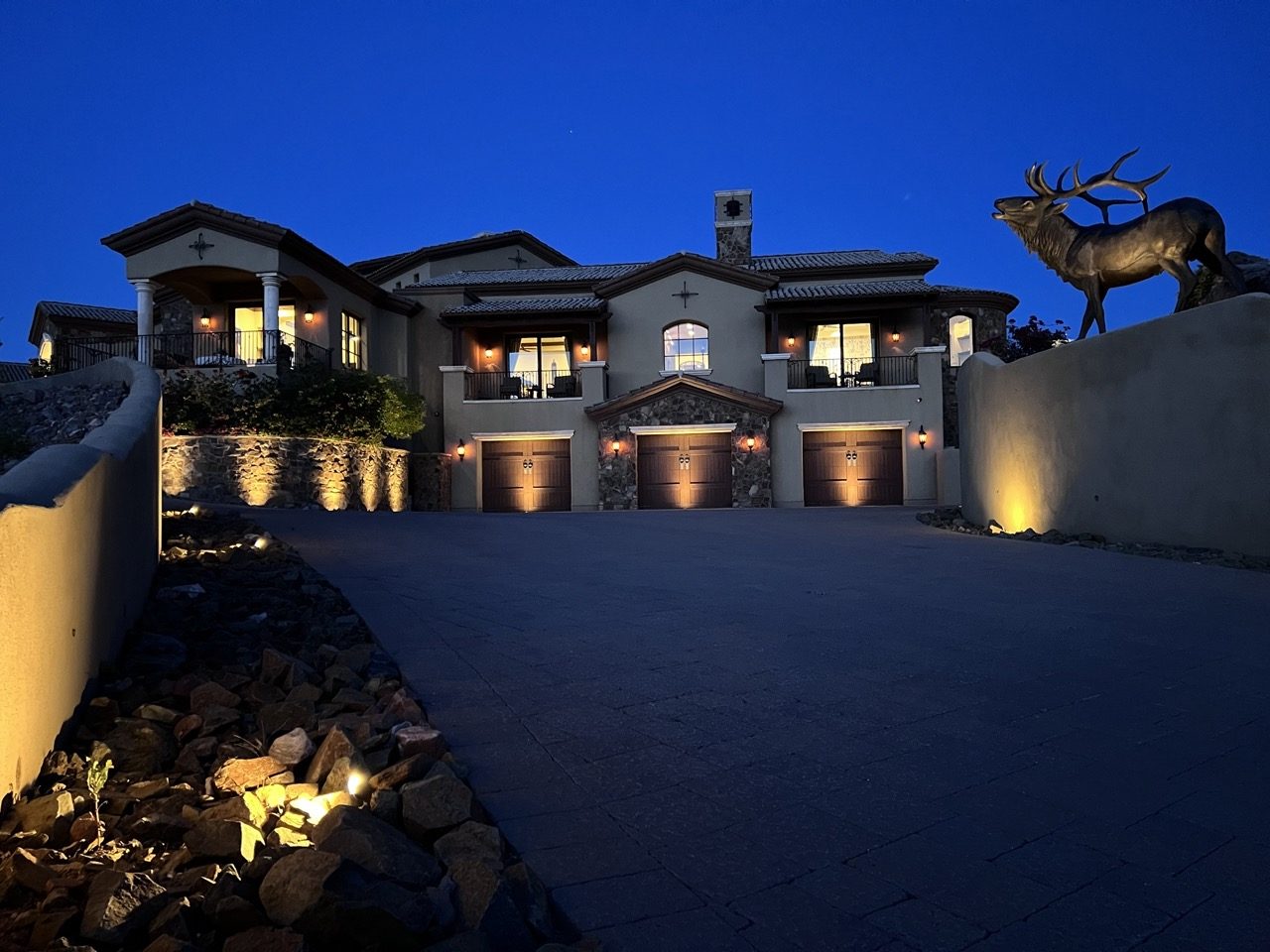
What actually changes on a large lot?
Three things, and they compound.
Voltage drop. Low-voltage systems lose voltage over distance. A fixture 200 feet from the transformer on undersized wire may receive meaningfully less voltage than one at 30 feet — and LEDs respond by dimming and shifting colour. On a small lot the runs are short enough that this rarely surfaces. On acreage it’s the single most common reason an expensive system looks cheap.
Transformer capacity and placement. Large properties usually need more total wattage than one transformer comfortably delivers, and a single central transformer means every run is long. The answer is generally multiple transformers positioned near the loads they serve, which requires planning power locations before anything goes in the ground.
Wiring topology. Daisy-chaining fixtures one after another guarantees the last one gets the least voltage. On larger designs we use hub or split configurations so fixtures sit at comparable electrical distance and the output stays consistent across the property.
How distance actually gets compensated for
Voltage drop isn’t a flaw to be avoided — it’s physics, and it gets designed around. The fundamentals are the same ones behind any professional low-voltage landscape lighting installation — the difference on acreage is that there is no margin for skipping the math. There are four levers, and a good design uses all of them together rather than leaning on one.
- Multi-tap transformers. Quality low-voltage transformers offer several output taps rather than a single 12V terminal. A short run near the transformer goes on a lower tap; a long run to the back of the property goes on a higher one, so it arrives at the fixture at the right voltage. This is the primary tool, and a transformer without multiple taps is a warning sign on any property this size.
- Wire gauge. Heavier conductor loses less voltage over the same distance. Standard runs use a common landscape gauge; long runs to distant zones get stepped up to heavier wire. Wire is the cheapest part of the system and the most expensive thing to change later, so it’s the wrong place to economise.
- Splitting the load. Rather than one long chain, runs get broken into shorter branches leaving the transformer, or fed as a hub so fixtures sit at comparable electrical distance. Fewer fixtures per run means less cumulative drop along it.
- Transformer headroom. Loading a transformer to its rated maximum leaves nothing for future fixtures and no margin for the system to breathe. Designing to a comfortable percentage of capacity is standard practice — and on a property where you’ll almost certainly add lighting later, it’s what makes that expansion a simple job instead of a new transformer.
There’s no standard set of numbers that gets applied to every property. The right tap and the right gauge fall out of the specifics of each individual run — its length, its load, how many fixtures sit on it — and on a large lot that math gets done run by run. That calculation is the work. Plenty of installs skip it entirely and wire by feel, which is precisely why so many big properties end up with a dim, off-colour back yard. None of it is visible in a finished install. It’s entirely why one system still looks correct in year five and another looks tired by the second summer.
Why the far end of the yard looks different
This is the complaint we hear most from owners of larger homes who’ve had lighting installed before: the front looks great, the back looks flat. Almost always it’s voltage drop, and almost always it traces to one transformer, undersized wire, and a long daisy chain.
The tell is colour. Underdriven LEDs don’t just dim — they shift. Put a correctly powered fixture beside an underpowered one and the second reads slightly yellow-green and lifeless. Once you’ve noticed it on your own property you can’t stop noticing it.
Zoning: the part large properties actually feel
On a big lot you rarely want everything on at once. A well-zoned system separates the entry and driveway approach, the front architectural and specimen lighting, the rear entertaining areas, and any pool or water feature — so the entry and drive can run late while the back garden shuts down at eleven.
Zoning also makes the system serviceable. When one zone behaves oddly, we’re diagnosing a defined section rather than tracing a single circuit across two acres. It costs a little more at install and saves considerably every year after.
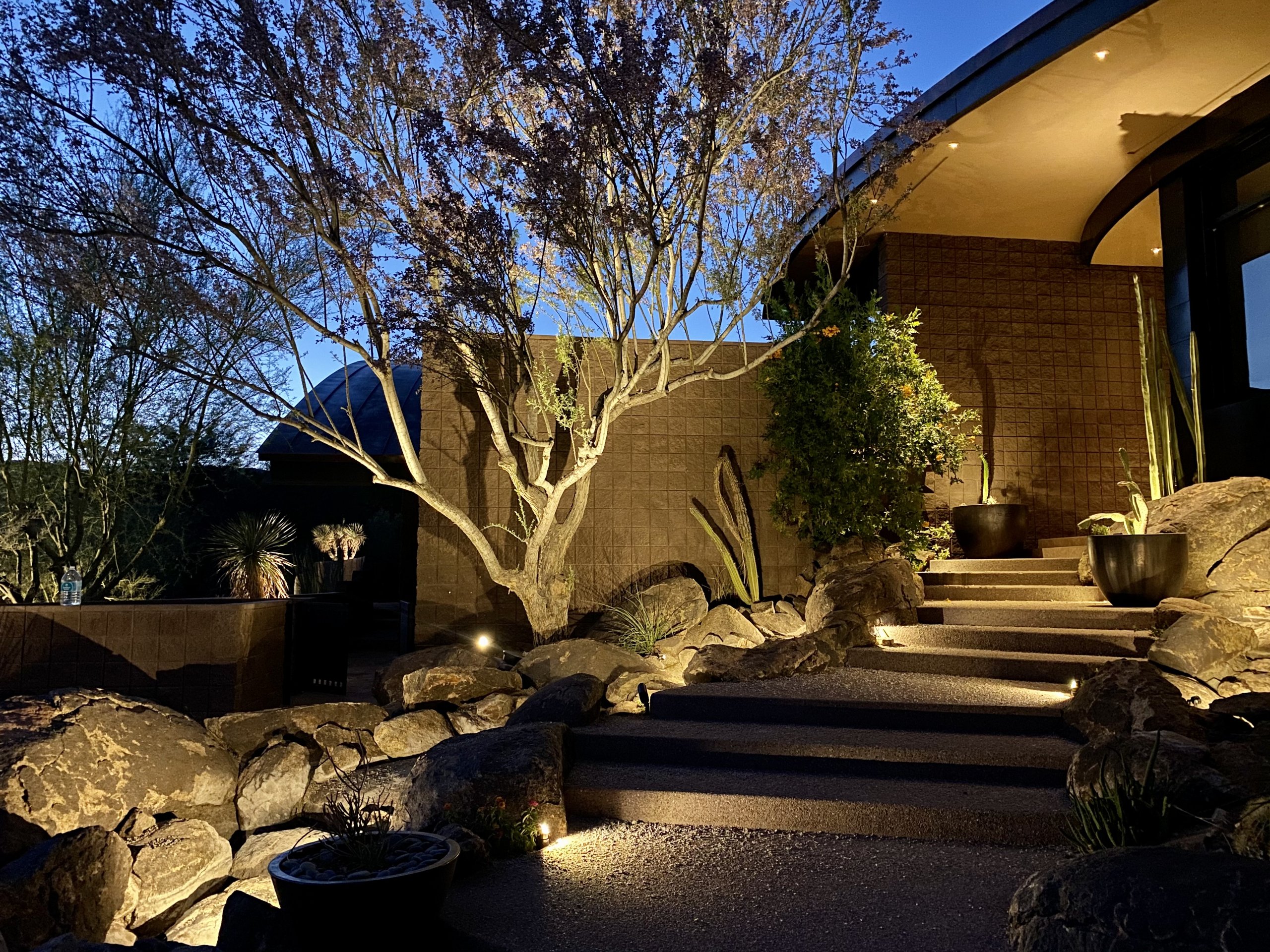
Long driveways and gated entries
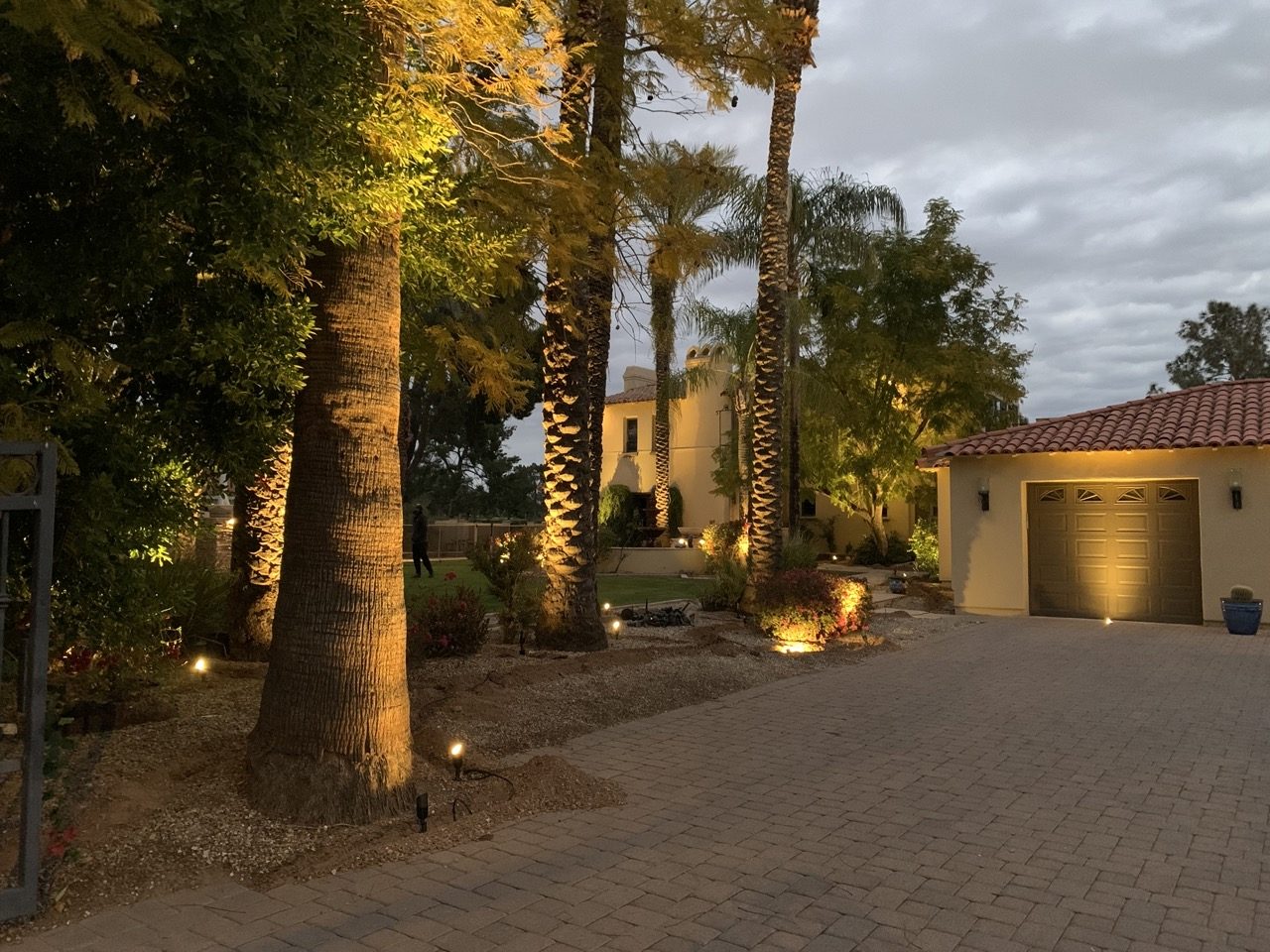
A 300-foot drive is its own design problem. Lighting it like a walkway produces the runway effect at scale, and the fixtures are far enough apart that gaps read as dark voids rather than shadow. What works better is anchoring the entry and the gate properly, then lighting what’s beside the drive — specimen trees, walls, grade changes — so the eye follows a sequence of lit objects rather than a row of lamps.
Practically, a long drive also means real wire runs and often a dedicated transformer near the entry. Worth knowing before you get a quote that doesn’t mention either. More on the approach itself in pathway lighting.
Mature specimen trees change the math
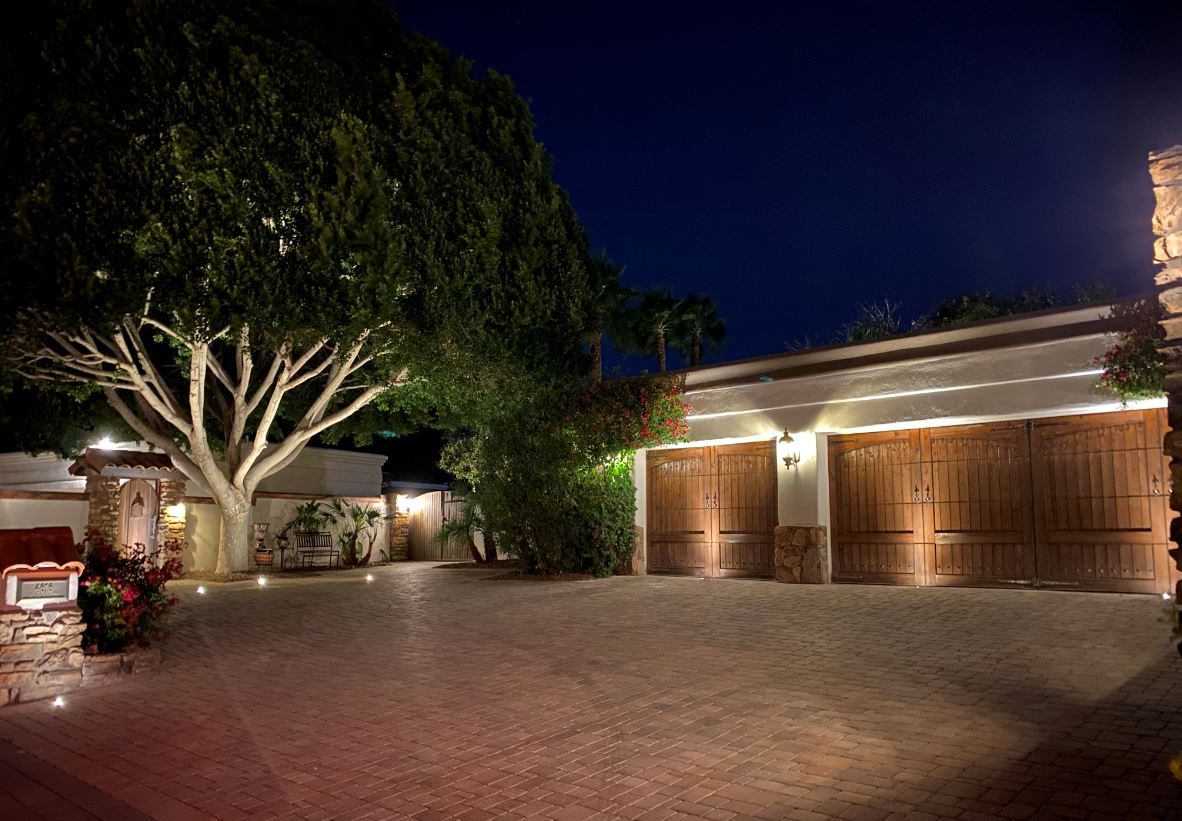
Larger properties tend to have the trees that make lighting worth doing — mature mesquite, palo verde, and multi-arm saguaro. These aren’t one-fixture jobs. A large canopy typically takes two or three fixtures at different angles to avoid the flat, floodlit look, and a tall saguaro needs a narrow beam placed close enough to carry the full height without spilling onto the house. Saguaros also carry their own constraints — they’re protected, shallow-rooted, and nothing should ever be fastened to the plant, which we cover in uplighting a mature saguaro without damaging it. If you are still deciding which features on the property are worth lighting, these landscape lighting ideas for your home are a sensible place to start.
Budget by feature rather than by fixture count. Six specimen trees done properly will outperform thirty path lights on any property this size. We go deeper on the technique in desert landscape and tree uplighting, and on the specific case of a mature saguaro, where the plant’s protected status changes how the fixture is placed.
HOAs, commercial sites, and multi-acre properties
On a community entrance, a commercial campus, or a multi-acre estate, the distances get long enough that low-voltage wire alone stops being the answer. The standard approach is to run line voltage out to transformer locations positioned near the areas being lit, then step down locally — so the low-voltage runs stay short even though the property is enormous. That’s licensed electrical work, and it needs to be planned before anything goes in the ground rather than discovered halfway through.
A few things change at this scale beyond the electrical:
- Zoning by area, not just by look. On an HOA property, separating the monument sign, the entry drive, the common areas, and each amenity means a fault is isolated to one section — and it makes billing and scheduled service straightforward.
- Control that doesn’t need a person. Astronomic timers and photocells keep everything on a consistent dusk-to-schedule cycle across the whole site, so nobody’s manually switching zones as the seasons shift.
- Serviceability designed in. Fixtures on a commercial site get hit by landscapers, irrigation, and vehicles. Placement, wire routing, and access all get planned around the fact that maintenance will happen — because it will.
- Scheduled maintenance rather than call-outs. A community entrance with three dark fixtures reads as neglect to every resident and visitor who passes it. Regular service visits catch that before the board hears about it.
We handle HOA common areas, community entrances, restaurants, retail, offices, and dealerships — see commercial outdoor lighting for how those projects run, including COI and scheduled service.
What it costs on a large property
Our packages start at $2,500, and a typical Phoenix front-yard design runs $3,000 to $7,000 installed. Larger properties move above that range, and the drivers are the ones above — fixture count, multiple transformers, longer and heavier wire runs, and trenching through established hardscape or planting.
Worth saying plainly: on a property this size the cheapest quote is usually cheap because it skipped the electrical planning. One transformer and thin wire will pass inspection on day one and disappoint you by month six. Ask any bidder how many transformers they’re specifying and what wire gauge they’re running to the far zones — the answer tells you what you’re buying.
See landscape lighting for how a full design comes together, architectural lighting for the house itself, or security lighting if the dark perimeter is the concern.
Frequently Asked Questions
How many transformers does a large property need?
It depends on total connected wattage and how spread out the fixtures are, not on lot size alone. The principle is to place transformers near the loads they serve so no run is longer than it has to be — which on acreage usually means more than one.
Why do my existing lights look dimmer at the back of the yard?
Almost certainly voltage drop. Fixtures at the end of a long run receive less voltage than those near the transformer, and LEDs respond by dimming and shifting colour. It’s usually fixable by re-splitting the runs, upsizing wire, or adding a transformer — it rarely requires new fixtures.
Can you expand an existing system across a bigger property?
Often yes, but the first question is whether the current transformer has spare capacity and whether existing runs can carry more load. Adding fixtures to an already-strained circuit makes every fixture on it worse, so it’s worth checking before extending.
Is it better to light more area or fewer features well?
Fewer features, done properly — especially on a large lot. Spreading a fixed budget thin across a big property produces weak light everywhere. Six well-lit specimen trees and a properly lit entry beat thirty underpowered fixtures every time.
Do very large sites still use low-voltage lighting?
Yes — the fixtures stay low-voltage. What changes is that line voltage gets run out to transformer locations near each area, so the low-voltage runs stay short. You get the safety and flexibility of low-voltage fixtures without fighting distance across the whole site.
How is an HOA or commercial project different?
Mainly zoning, control, and service. Zones get separated by area so faults stay isolated and billing is clean, control runs on astronomic timers so nobody switches anything manually, and the system is laid out assuming landscapers and irrigation will interact with it. Scheduled maintenance matters more than on a residence, because dark fixtures at a community entrance are visible to everyone.
Designing for a larger property?
Free after-dark walkthrough and a design that accounts for the electrical, not just the fixtures. We design. You shine.

